

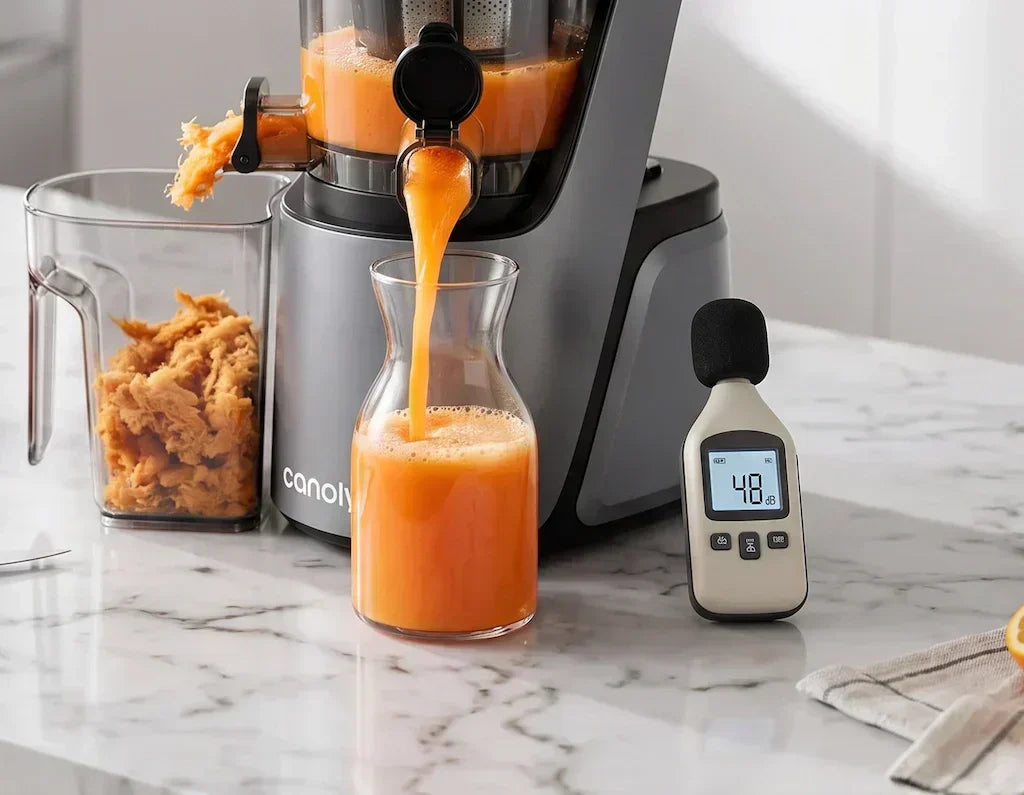
A blender at 6:30 a.m. is a household event. A centrifugal juicer at 6:30 a.m. is a household crisis. If you've ever crept around your kitchen trying to make celery juice without waking a toddler, a partner, or the neighbors through a thin apartment wall, you already understand why "quietest juicer" is one of the more honest searches in the appliance world.
The good news: juicer noise isn't random. It's a direct function of motor type, RPM, and housing design — three measurable variables. Once you understand them, picking a quiet machine becomes straightforward.

What Counts as a "Quiet" Juicer?
A quiet juicer is one that operates at or below 60 dB during normal use — quieter than a typical conversation — measured 1 meter from the unit while juicing fibrous produce like celery or kale.
For context, here's how juicer noise stacks up against everyday sounds:
| Whisper | 30 dB |
| Refrigerator hum | 40 dB |
| Normal conversation | 60 dB |
| Vacuum cleaner | 70 dB |
| Blender | 80-90 dB |
| Lawnmower | 95 dB |
Decibels are logarithmic, not linear. A jump from 50 dB to 60 dB sounds roughly twice as loud to the human ear, and 60 dB to 70 dB doubles it again (Acoustical Society of America reference data).
So a 48 dB juicer isn't "a little quieter" than a 78 dB one — it's perceptually around 8x quieter.
Do Juicers Make a Lot of Noise?
Centrifugal juicers do. Masticating (slow / cold press) juicers generally do not.
The two categories produce dramatically different noise profiles:
| Juicer Type | Typical RPM | Typical Noise (1m) |
| Centrifugal | 6,000-14,000 | 80-90 dB |
| Vertical masticating | 40-80 | 45-60 dB |
| Horizontal masticating | 60-110 | 50-65 dB |
| Twin-gear/ triturating | 80-160 | 55-70 dB |
(Range data compiled from Consumer Reports juicer testing 2023 and Serious Eats 2026 juicer reviews.)
The reason is mechanical. A centrifugal juicer spins a flat blade-disc at ~10,000 RPM, then flings pulp against a mesh screen. That high-speed impact is what you hear. A masticating juicer rotates an auger at 40-80 RPM, crushing produce slowly against a screen — closer to the sound of a kitchen drawer rolling than a power tool.
What Actually Makes a Juicer Quiet?
Three engineering choices determine how much noise a juicer produces:
1. Motor Type: Brushless DC vs. Brushed AC
Brushless DC motors run quieter than brushed AC motors because they eliminate the friction of carbon brushes against a commutator. They also generate less vibration and run cooler, which means less housing rattle. Most juicers in the sub-50 dB range use brushless motors rated for 10,000-15,000+ hours of operating life.
2. RPM and Reduction Gearing
Lower auger speed equals lower noise. But "slow" alone isn't the whole story — *how* the juicer slows the motor matters. A high-RPM motor stepped down through a gearbox can introduce whine. A direct-drive low-RPM motor stays quieter throughout the press cycle.
3. Housing, Gaskets, and Foot Design
The same auger assembly in a thin-walled ABS housing versus a thicker housing with rubber-isolated mounting feet can vary by 5-10 dB in measured output. This is why two juicers with identical-on-paper specs can sound completely different on a hard granite countertop.

The Quietest Juicer Models Worth Considering in 2026
- Nama J2 Cold Press — Frequently named the overall winner by Epicurious (2026) and runs in the 50-55 dB range. Wide chute, slow auger. Higher price point ($550+).
- Hurom H320 — Manufacturer-published noise rating around 64 dB — quieter than centrifugal, but not the quietest in the slow category.
- Canoly C16 3-in-1 — A brushless-motor masticating juicer rated by the manufacturer at 48 dB during juicing operation, with a 50 RPM auger and rubber-isolated base.
The C16 also performs nut milk extraction and sorbet from the same auger assembly, which matters if you want one machine instead of three. Good entry-level option around $150.
What Juicer Does Martha Stewart Recommend?
Martha Stewart has publicly endorsed the Nama J2 Cold Press Juicer through her brand collaborations and content, citing its quiet operation and wide feed chute as reasons (Martha Stewart Living editorial, 2023). It's a slow masticating juicer in the 50-55 dB range and routinely lands at the top of editorial rankings.
That said, "Martha Stewart's pick" and "the right juicer for your kitchen" aren't always the same thing. The Nama J2 sits at $550+ and prioritizes juice yield over multi-function versatility. If you're juicing once daily and that's your whole use case, it's defensible. If you also want nut milk, sorbet, or smaller footprint, the calculus changes.
What Is the Difference Between a Juicer and a Masticating Juicer?
A masticating juicer is a type of juicer that uses a slow-rotating auger (40-110 RPM) to crush produce, while the broader "juicer" category also includes centrifugal models that use a high-speed blade-disc (6,000-14,000 RPM) to shred and spin produce.
| Centrifugal | Masticating | |
| Noise | 80-90 dB | 45-65 dB |
| Juice yield (leafy greens) | 40-55% | 70-90% |
| Oxidation / heat | High | Low |
| Juice shelf life | 24 hours | 48-72 hours |
| Prep time | Minimal (wide chute) | Moderate (smaller chute) |
| Price | $60-200 | $200-700+ |
(Yield and shelf-life data from Journal of Food Science cold-press extraction studies, 2018, and Consumer Reports juicer testing 2023.)
If noise is your primary concern, the category answer is masticating, full stop. There is no quiet centrifugal juicer on the market — the physics don't allow it.
If you're unsure which type to choose, learn the difference between masticating juicers and regular juicers.
What Is the Number One Rated Juicer?
The Nama J2 Cold Press Juicer holds the top editorial position across most 2026 lists, including Epicurious and several specialty publications.
The honest caveat: "number one rated" depends entirely on what's being weighted. Serious Eats (2026) prioritizes ease of cleaning. Allrecipes weighs yield. Bon Appétit factors in design. There's no universal #1.
For someone whose top three criteria are quiet operation, easy cleanup, and one machine handling multiple jobs, the conversation shifts away from single-function flagships and toward multi-function masticating units.
This is where models like the Canoly C16 — which extracts juice, nut milk, and sorbet from a 3-4 part assembly that rinses in roughly 60 seconds — earn their place. Not because they win every category, but because they reduce the friction of actually using the machine daily.

The Hidden Cost of a Noisy Juicer
The published research on appliance noise and habit formation is thin, but the behavioral pattern is well-documented in adjacent categories. James Clear's analysis of habit friction (Atomic Habits, 2018) holds that any environmental obstacle — including social cost — measurably reduces habit adherence. A juicer loud enough that you can't run it before your partner wakes up is a juicer you'll use 2-3 times a week instead of 7.
When I've talked with people who abandoned juicing within six months of buying their machine, the reason is rarely the juice itself. It's almost always one of three frictions: cleanup time, prep time, or noise restriction. Noise is the most underestimated of the three because you don't notice it in the store — only at 6 a.m. in your actual kitchen.
How to Test a Juicer's Noise Before You Buy
If you can't audition a juicer in person, you can still pressure-test the claim:
- Look for a published dB rating. If the brand won't print one, assume it's loud.
- Check the motor type. "Brushless DC" in the spec sheet is the signal you want.
- Check the RPM. 40-80 RPM is the slow-masticating sweet spot.
- Read reviews for "celery" or "kale." Fibrous produce is where noise differences show up. Soft fruit juicing tells you nothing.
- Watch video reviews with sound on, not just on mute. YouTube reviewers rarely edit out motor noise — listen to the background.
What About Centrifugal Juicers — Are Any of Them Quiet?
No. The quietest centrifugal juicers on the market still measure 75-80 dB during operation, roughly equivalent to a vacuum cleaner (Consumer Reports juicer testing 2023). The high-RPM disc is a structural requirement of how the category works. If quiet is non-negotiable, centrifugal is the wrong category — not the wrong product.
The trade-off: centrifugal juicers juice a whole apple in under 10 seconds. A masticating juicer takes 30-60 seconds for the same apple. If your morning routine has zero margin and you can't tolerate 30 extra seconds, that's a real consideration — just don't expect quiet alongside it.
FAQ
Q1: What is the quietest juicer you can buy in 2026?
The Nama J2 Cold Press, Kuvings REVO830, and Canoly C16 all operate in the 48-55 dB range, which is among the lowest published ratings in the masticating category. All three use brushless motors and auger speeds between 50-60 RPM. The exact "quietest" depends on the produce being juiced and the surface the unit sits on — granite amplifies vibration more than wood.
Q2: Is 60 dB loud for a juicer?
No, 60 dB is on the quieter end for a juicer. It's equivalent to a normal conversation and well below the 80-90 dB range of centrifugal models. Anything under 65 dB is considered quiet operation in this appliance category.
Q3: Why is my new juicer so loud?
It's almost certainly a centrifugal juicer, which runs at 6,000-14,000 RPM by design. The high-speed blade-disc is what creates the noise, and there's no fix beyond switching to a masticating model. Tightening the lid, adding a silicone mat under the base, and not juicing frozen produce can reduce noise by 2-4 dB, but they won't transform a centrifugal into a quiet appliance.
Q4: Do masticating juicers really last longer than centrifugal ones?
Yes, typically 2-3x longer based on motor hour ratings. Most masticating juicers use brushless motors rated for 10,000-15,000+ hours, while centrifugal motors are often rated for 3,000-5,000 hours (manufacturer spec sheets, 2026). Warranty lengths reflect this — masticating units commonly carry 10-15 year warranties versus 1-3 years for centrifugal.
Q5: Can I make nut milk in a quiet juicer?
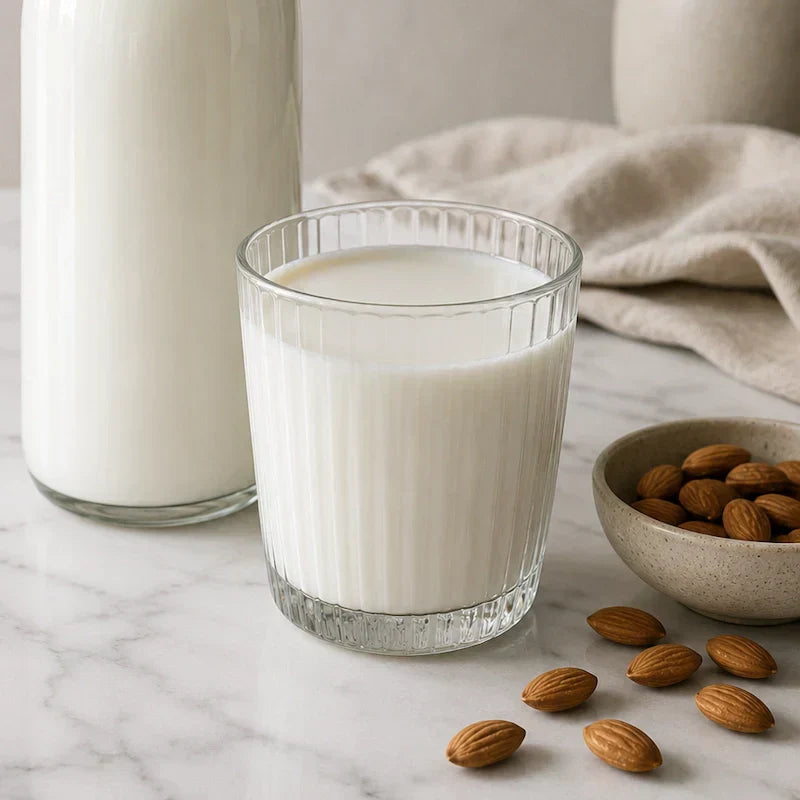
Yes, most slow masticating juicers can produce nut milk if the auger and screen handle soaked nuts. Soak almonds 8–12 hours, cashews 4–6 hours, then run them through the juicer with filtered water at a 1:3 nut-to-water ratio.
You can also try this homemade apple nut milk recipe.
The 50-RPM action that makes masticating juicers quiet also makes them effective for nut milk — and in 3-in-1 units like the Canoly C16, the same assembly handles juice, nut milk, and sorbet without a separate appliance.
Aktie:
Do you have to peel ginger before juicing?
7 Cold Press Juicer Recipes for Beginners (With Exact Ratios)