

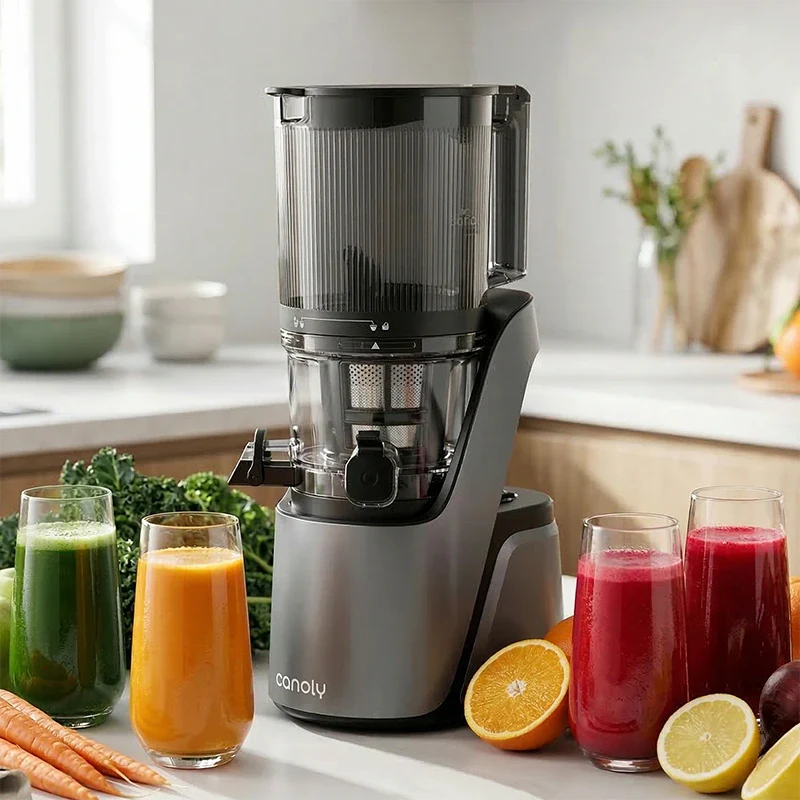
Is cold pressed juice good for you?
Yes, cold pressing retains more nutrients compared to traditional juicing methods. Over time, this can make a meaningful difference for people who drink juice regularly for health.
Why?
Cold-pressed juice extraction avoids heating, thus protecting heat-sensitive vitamins, enzymes, and polyphenols, and slowing down oxidation. Traditional juicing methods generate friction and heat, which can damage nutrients, accelerate oxidation, and cause fruits and vegetables to lose their fresh flavor.

5 Advantages of Cold Pressed Juice
1. More nutrients – Slower spin, less heat, more nutrients retained
Centrifugal juicers can spin at 6,000 RPM or more. The high-speed friction may generate temperatures up to 140°F. In contrast, cold-press juicers operate at a slow speed, typically around 40 RPM, using pressure to slowly extract juice with minimal heat buildup.
Research indexed by the NCBI shows that cold-press extraction, with low oxygen and low temperature, better preserves the initial bioactivity of juice.
2. Less Oxidation – Reduced oxygen contact extends nutrient life
Centrifugal juicers extract juice through high-speed spinning, which not only creates excessive foam but also introduces air that oxidizes the juice. Cold-pressed juicing, on the other hand, slows oxidation and helps maintain freshness.
Experimental data reported by Goodnature show that after 48–72 hours of refrigeration, vitamins A and C in centrifugal juice dropped by up to 46%, while cold pressed juice showed only about 12% nutrient loss.
3. Higher Juice Yield – Produces more juice and reduces food waste
Cold-press juicers extract more juice from fruits and vegetables, especially leafy greens, through deep mechanical pressing. A study published in the journal Food Science & Engineering in 2024 found that cold-press technology achieved a juice yield of 92% with juicy soft fruits, compared with only 47% for standard centrifugal juicers. For hard fruits, cold-press yield was 66%, versus 50% for centrifugal juicers.
This means that with the same amount of produce, cold-press devices can produce significantly more juice.
4. Better flavor – Preserves natural taste, more like real fruit
Heat not only destroys some heat-sensitive nutrients, as we mentioned above, but also makes juice taste “cooked.” Sometimes, it gives an overripe or slightly off flavor.
Cold-pressed juice, extracted without heat, retains more natural tastes, closer to fresh fruit—vibrant, refreshing, and naturally sweet. Many people who drink juice regularly describe cold-pressed juice as tasting closer to freshly squeezed produce, with a naturally sweet flavor and brighter aroma.
5. Longer Storage Time – Stays fresh longer, convenient for batch preparation
Because cold-pressed juice exposes very little air during extraction, it stays fresh much longer than conventional juice. Data show that after 72 hours (3 days) of refrigeration, cold-pressed juice maintains extremely stable levels of nutrients and flavor, without the rapid oxidation or separation typical of ordinary juice.
This means cold-pressed juice retains its nutrition longer than conventional juice in the fridge.
Learn more about the differences between cold press juicers and regular juicers in our complete guide: Are Cold-Pressed Juices Healthy? Cold Press Juicer vs Regular Juicer
References
- National Center for Biotechnology Information: Effects and Mechanisms of Fruit and Vegetable Juices on Cardiovascular Diseases
- Goodnature Products: Cold-Pressed vs. Centrifugal Juice – Nutrient Shelf Life
- Food Science & Engineering: Cold Pressed vs. Centrifugal Juice: Comparison in Terms of the Juice Yield, Physicochemical and Phytochemical Properties


Share:
Best Containers for Storing Juice: Tips to Keep Juice Fresh Longer